
Blog Posts
Types of Boundaries
Hello Friends,
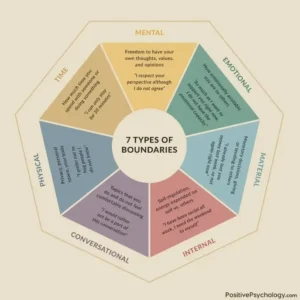
Let’s continue talking about boundaries. Last time I talked about the difference between having rigid, porous, and more healthy boundaries. I wanted to discuss the 7 types of boundaries and what they look like. I have included a graphic summary at the end with an example that helps illustrate each type.
Time: We all have the same 168 hours in a week. Some of our time goes towards necessities of life such as sleep and financial income. Boundaries around time come down to how we use the time we have. A way to practice more healthy boundaries with time is exploring what areas are most important and setting aside time for each of those areas. Time boundaries can be violated when someone or something is taking up too much time. An example of setting a time boundary is not working more than 40 hours a week if that is how much you get paid to do and if there are other areas of your life you want to put the rest of your time towards.
Physical: Personal space and physical touch are different for each person. Healthy physical boundaries include an awareness of what is appropriate and not appropriate in different settings and with different relationships.
Conversational/Intellectual:Sometimes there are people in our lives we just can’t discuss certain topics with, and that is ok. Conversational boundaries include topics that you do and do not feel comfortable discussing in certain settings or with certain people. Some topics can be triggering for those of us who have experienced a form of trauma in our life. Reserving the right to walk away from a conversation or setting a boundary that you would rather not discuss a topic is an example of a healthy boundaries.
Internal: Our internal boundaries are the boundaries we set with ourselves. What we do, say, think, and feel are our responsibility and our internal boundaries. What we do to take care of ourselves are our external boundaries. External boundaries are those we set to protect ourselves from others. One way to set an internal boundary I have found to be helpful is to look at my thoughts more from a curiosity standpoint instead of viewing them as negative thought or a thought I need to defend. A boundary can also look like recognizing the need for alone time to practice self care and self regulation.
Material: These boundaries refer to money and possessions. Healthy material boundaries involve setting limits on what you will share, and with who. This also includes who you will spend your money on. I have also used material boundaries for myself such as having a budget and not overspending to protect myself from my sometimes impulsive spending habits.
Emotional: This is about our feelings. It is also about how emotionally available we are to others. Do we spend too much of our time being emotionally available to other people in our lives or people who don’t show up the same way? Healthy emotional boundaries include limitations on what we will share and how much personal information we will give depending on the relationship. They also include protecting our emotional capacity and when we can and can’t be available to the people in our lives. Referring back to a previous blog post on relationship bullseye, the emotional capacity I have for people inside my bullseye is going to be different than the emotional capacity I have for people who are not as close or as supportive.
Mental: Mental boundaries are about the freedom to have your own thoughts, values, and opinions. You have the right to your own thoughts, values, beliefs and opinions. It is important to give and receive respect when it comes to mental boundaries. It is ok to disagree with people, it is ok to allow people to have their own values, beliefs, and opinions while staying true to yours.
Until next time.
Emilie Barragan, LCSW